Every story
has an owner
A nonprofit's guide to ethical storytelling, and to what happens to a person's story once it enters your reporting.
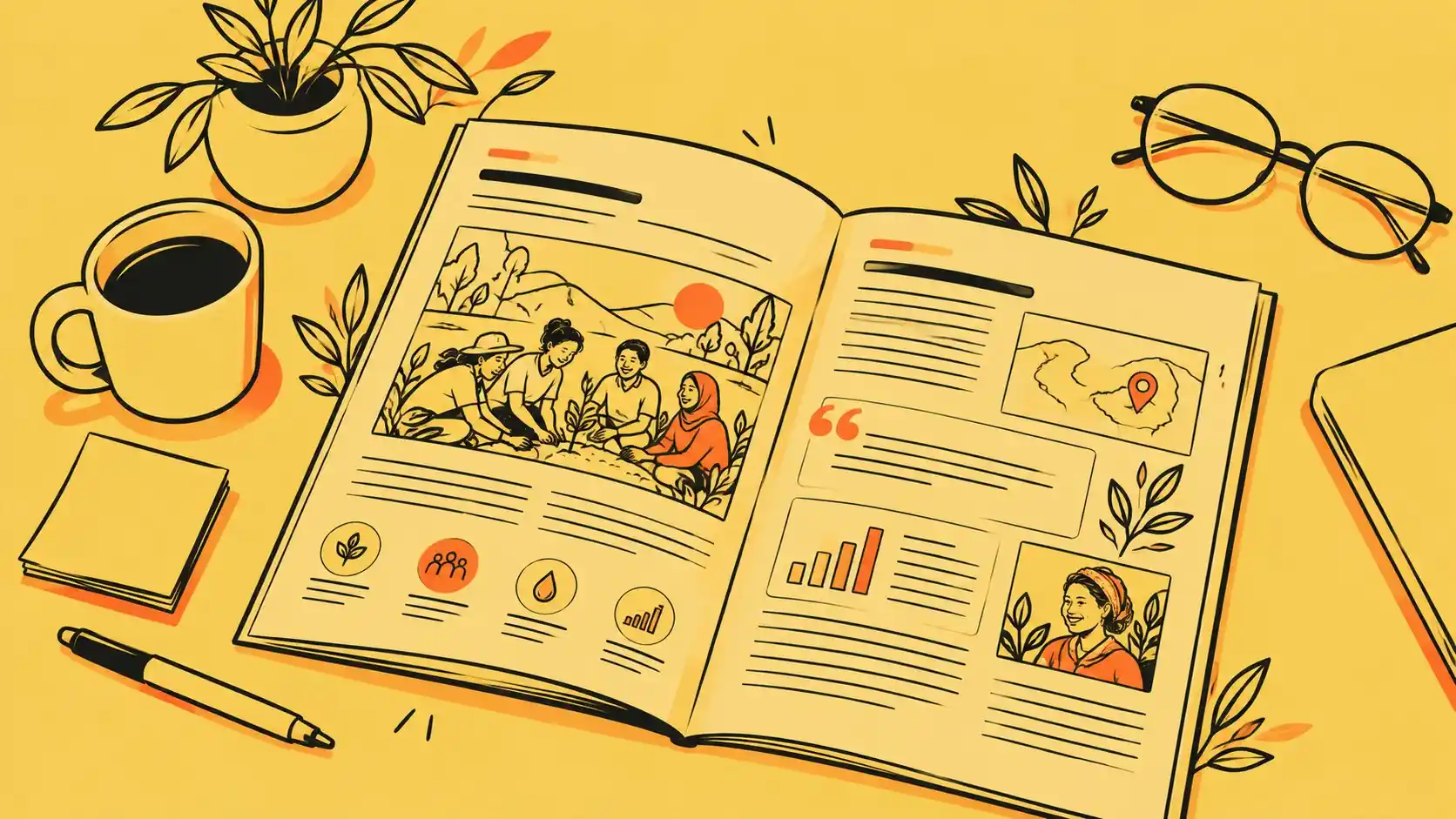
The page people remember in your annual report is a face.
Think about the last report you worked on. The charts took weeks. The budget tables took longer. But the page people remembered was a girl reading aloud, a health worker on her rounds, or a father outside the shelter he helped rebuild.
Those pages build trust with funders faster than any chart. They also carry our sector's quietest responsibility.
Ethical storytelling isn't just better storytelling. It changes the relationship between your organization and the person whose story you tell.
Because the real issue isn't only how a story is told. It's what happens to someone's story once your organization takes it into its reporting and communications system. Where it travels. Who edits it. Who sees it. And whether the person ever gets a say again.

A "story" is a lot more than a photo
Every one of these carries a piece of someone's life. Every one can be shared, reused or misread.
Who we mean by "nonprofits"
Our sector goes by many names, depending on where we're registered and how we work. This is for all of us:
- NGOs and INGOs, running programs directly or through partners
- Charities and public charities, including 501(c)(3)s and their equivalents
- Implementing partners, who deliver funded programs and gather most stories
- Community-based organizations, self-help groups and cooperatives
- Foundations and grantmakers, private, family, community and corporate
- Humanitarian agencies, faith-based organizations, networks and CSOs
Nonprofit teams often ask us...
How do we get real consent when people depend on our services?
Can we reuse last year's photos in this year's appeal?
What do we tell a funder who wants faces by Friday?
A story has a life of its own. Publishing is only step five.
Most of our care goes into collecting and creating. But a story keeps moving long after the report goes out. Responsible practice follows it all the way round.
- Collect
- Consent
- Create
- Review
- Publish
- Reuse
- Withdraw or retain
Where a story can change
Every stage is a hand-off. At each one, something about the story can shift without anyone meaning it to.
Save this one for your next team meeting
The hand-off problem between funders and partners
Here's a pattern we see often. A foundation asks a grantee for stories. The grantee asks its implementing partner. A field officer asks a community member, usually for one specific report.
The story then travels back up the chain, and gets used in places nobody mentioned at the start: the foundation's annual review, its board deck, its website. Consent is gathered at one end. The story is used at the other. And often, nobody in the middle owns the record of what was agreed.
That's no one's failure alone. It's a gap in the system, and it's one funders and partners can close together.
UNHCR puts it plainly: images without consent can't be used, especially for fundraising.6

This isn't a new concern. The standards have evolved.
Our sector has been working on this for decades, and most of the standards came from nonprofits themselves. Read in order, they tell a story of their own. Each generation added a new layer of care.
Representation and dignity
Stop showing people as symbols of need. The 1994 Code of Conduct asked that people be shown "as dignified human beings, not hopeless objects."1 CONCORD's 2006 code built on dignity, equality and justice.2
Voice and participation
Let people shape their own stories. Dóchas made contributor-led stories a core commitment.3 The Dignified Storytelling Handbook added ten principles and a public pledge.11
Informed consent
Consent as a documented process, not a signature. UNHCR's 2023 guidelines made it a core principle.5 The 2024 Core Humanitarian Standard applies it to communications "including those used for advocacy and fundraising."4
Safeguarding
Safety before visibility. UNICEF puts a child's best interests "over any other consideration, including over advocacy."9 National codes such as ACFID's add approval protocols that credit partners.10
Digital and AI integrity
Keep the real, real. Bond's 2024 guidelines added chapters on stock imagery, news agencies and AI-generated images.7
Slate of Swan is an impact communication advisory, based in India and working across the global impact space.
Everyone agrees it matters. So why is it still so hard?
Nobody in our sector sets out to exploit anyone. The gaps come from how the work actually runs, in very different contexts. Sound familiar?
Saying no isn't always easy. When someone relies on your services, "yes" can reflect gratitude or worry as much as choice. Language and literacy gaps make it harder still.
Funders ask for faces, fast. Reporting templates want photos and "beneficiary stories" by a deadline. The easiest image isn't always the right one.
The comms team might be one person, or nobody. Program staff take photos on their phones between site visits, with little training on consent.
Archives outlive their permissions. Bond notes that many NGOs hold images from before May 2018 with no evidence of consent at all.8
Contexts change the rules. A photo that's fine in one district can be dangerous in a conflict zone. Data and child protection laws differ across the countries where we register, fundraise and work.
Is it really being taken care of?
Our honest answer: unevenly. A few recent moments show the gap.
- 2023. Amnesty International withdrew AI-generated images of protests in Colombia after photographers and journalists criticized them.13
- 2023. ALNAP reported that photo libraries had sold MSF images of identifiable, vulnerable people taken at its facilities.12
- 2024. The revised Core Humanitarian Standard strengthened its communications language after a global consultation.12
These organizations have real commitment and real resources. That's the point. Good intentions alone don't make a system.
Where this shows up in your work
Your stories also travel into your funders' reports. As sustainability reporting becomes more evidence-driven, case studies increasingly sit alongside disclosures on communities, human rights and social investment. That makes accuracy, context and traceability important not only for the numbers, but for the stories used to illustrate them.
The question isn't whether to tell these stories. It's whose story it is, and whether the telling respects them.
If you remember one thing
Four red lines no deadline should cross
- 1No consent
There's no documented, informed consent for this specific use.
- 2Risk of harm
Publishing could expose the person, their family or community to harm, stigma or retaliation.
- 3A child at risk
A child is identifiable in a context of risk, abuse, conflict, health or legal proceedings.
- 4Not what happened
An image or story is staged, synthetic or altered and presented as fact.
If any of these is true, hold the story until it's resolved.
Responsible communication is part of responsible impact
At Slate of Swan, we spend our days inside nonprofit stories: annual reports, project reports for donors, impact reports, funder decks, and the websites and campaigns in between. We've sat with the same tension you do. A deadline on one side. A person on the other.
So we've come to see this work as part of the impact itself, not a finishing touch. We help teams build it into practice in three ways.
- Story governanceConsent, ownership, reuse and approval frameworks that work across your team and your partners.
- Story reviewChecking representation, evidence, context and risk before anything is published.
- Story designTurning verified, contributor-led stories into annual reports, impact reports, funder decks and communications.
We all know it matters. Doing it consistently is the hard part.
Every team we speak with cares about this. What's hard is doing it the same way every time, across different programs, partners, countries and contexts.
So our team has put together a checklist guide. It brings together good practices from the standards above into one practical tool. Share it with your team so everyone starts on the same page. Use it as a base to shape your own storytelling SOP.
Because we work in this space every day, we see sharing it as part of our duty. It's a knowledge initiative, ready to use, and free for every nonprofit that wants to calibrate its impact communication.